
Episode 5
Fasting, protein, strength training, and brain health
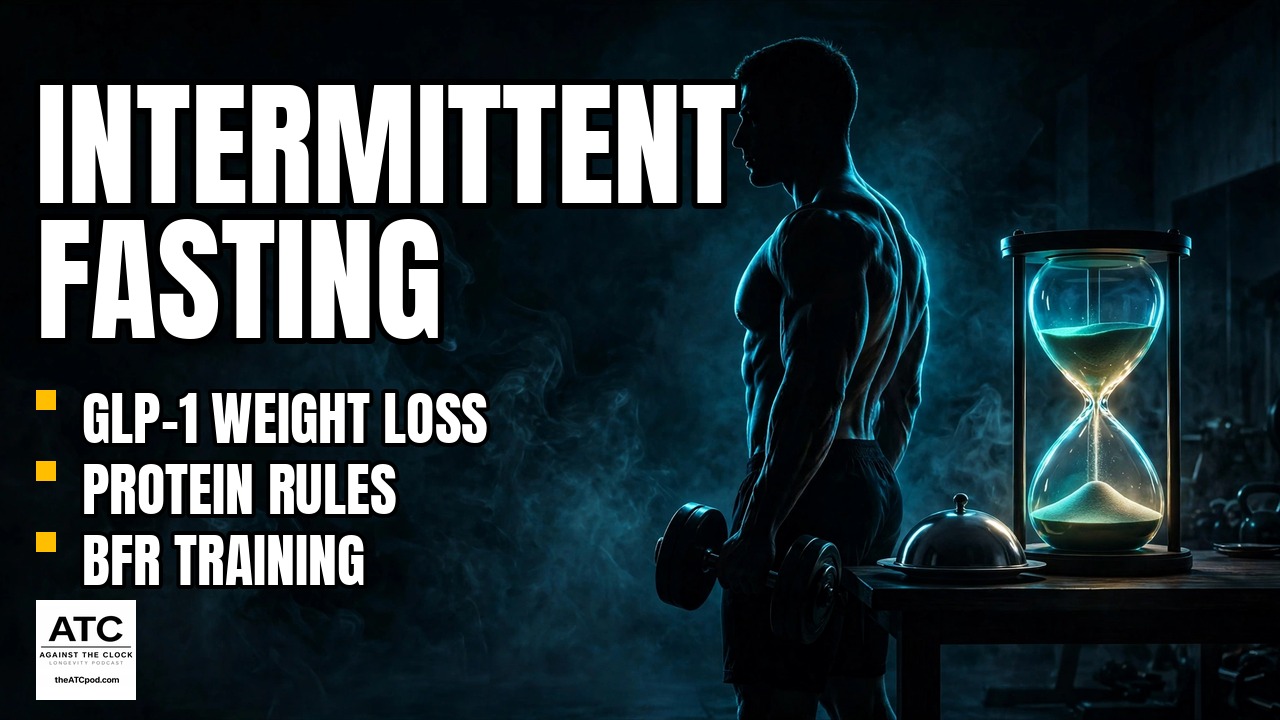 Releases November 26
Whether a GLP-1 counts as fasting, why building and cleanup do not happen at the same time, how to get enough protein, the case for lifting over cardio, and what we do and do not recommend for the brain.
Patients ask us the same four questions in different words. When should I eat more, and when less? Should I fast? What should I be doing in the gym? And what keeps my brain working? This episode goes through them in that order. The table agreed on strength and disagreed, in places sharply, on fasting and on how many supplements a brain needs.
Is a GLP-1 a form of fasting?
Fasting has fallen out of the conversation since the GLP-1 drugs arrived, and one reason is simple: people on them are not hungry. That raised a question we had not put to each other before. If these drugs work by making people eat less, is that the same thing as a fast?
The argument that it is not: a fast is a stretch of hours with nothing coming in, long enough for the liver to finish processing and for cells to switch from taking in fuel to clearing out damaged parts. A GLP-1 slows stomach emptying, so food trickles into the system for longer. Total calories fall, and the empty stretch may never arrive. Calorie restriction and fasting can produce the same number on the scale by different routes.
Whether someone who fasts while on a GLP-1 gets the cleanup benefit was left open. No one at the table knew of data that answers it.
Why fasting lost its following
Two explanations were offered, and both may be true. The first is that the drugs made eating less easy and nobody profits from teaching people to skip breakfast. The second is that the promised cellular benefits, autophagy most of all, were demonstrated mainly in animals, and the human studies that followed were less impressive than the early enthusiasm.
One limit was stated plainly. Long-term calorie restriction extends life in mice, and those mice are frail. Living longer and weaker is not what our patients are asking for.
Building and cleanup are different modes
This was the organizing idea of the first half. The body runs two programs that pull in opposite directions.
- Growth. Signaled through a pathway called mTOR. Protein, resistance training, and anabolic hormones turn it on. It builds muscle and bone.
- Cleanup. Signaled through a pathway called AMPK. Fasting, lower protein, and lower-intensity exercise turn it on. It clears damaged cell parts and worn-out cells.
A person who lifts hard for muscle while fasting sixteen hours every day is asking for both programs at once and getting less of each. The case made for cycling: spend a stretch of weeks building, then a shorter stretch easing off and letting the cleanup run. One of us does this by season, building for part of the year and leaning out for another, on the reasoning that human food supply was seasonal for most of our history.
Three objections came from the same table.
- A twelve to fourteen hour overnight gap is not going to undo anyone's training. It is the daily sixteen-hour fast combined with a building program that conflicts.
- Cycling is too complicated for most patients. The best plan is the one a person will follow, the same principle we apply to hormone delivery.
- Not everyone needs variety. One of us has eaten nearly the same meals on the same schedule for decades, has held the same weight, and has more muscle now than ten years ago. A metabolically healthy person with a stable routine may not need to change it.
The case against fasting in older patients
The strongest objection to fasting at this table comes from body-composition scans. Patients who fast heavily tend to come back a year later with less lean mass and weaker results on basic strength testing. A seventy-year-old who has lost that muscle faces a hard climb to get it back.
Time-restricted eating does have one real advantage: it is psychologically simple. A fixed eating window removes a hundred small negotiations a day. The cost is that the window has to hold a full day's protein, and for many people it does not.
A practical suggestion that came out of this: let the sport decide. Lean out for the season when being lighter helps and build for the season when mass helps. The body gets both modes, and the plan follows something the patient enjoys.
Getting enough protein
Everyone agreed that most patients fall short on protein, and that a GLP-1 makes it harder because appetite is suppressed.
Does timing matter? The old rule that the body can only use a fixed amount of protein per meal was challenged. The view at the table is that the limit was observed with fast-absorbing liquid protein, and that a large serving of whole-food protein is digested and released over many hours. Studies point both ways on whether protein has to be spread across the day or simply reached by the end of it.
What works in practice.
- Front-load the day. A protein-heavy first meal, before the day gets busy, takes pressure off the rest.
- Add a few bites to meals already being eaten. One more egg at breakfast and part of a second chicken breast at lunch is easier than fitting in a fourth or fifth meal.
- Cottage cheese, yogurt, seeds, and eggs are the usual ways to raise the total without a supplement.
Shakes, bars, and amino acids. Whole food was the shared preference. On bars and shakes the table split: one view is that most are loaded with additives, the other is that clean versions exist and are useful, especially for someone who does not eat meat. On amino acid supplements, one of us has seen liver enzymes double in patients taking large amounts and return to normal when they stopped. Others have not seen it. That is an observation from practice, not a study, and it is a reason to mention these products to your doctor if your liver tests change.
Strength is the priority
There was no disagreement here. The activities that decide whether an older person lives independently, carrying groceries, getting up from the floor, working in the yard, depend on muscle. One of us put it as strength tracking healthspan more closely than it tracks lifespan.
Lifting over cardio. One of us used to prescribe mostly cardio and now tells patients to spend most of their training time on resistance work, because muscle raises resting metabolism and protects function. The exception is a patient with a poor measured VO2 max, who needs the aerobic work first.
Balance. Falls and the hip fractures that follow them are a major cause of disability and death after 65. That argument rarely motivates a fifty-year-old. What does: balance makes you better at whatever you already enjoy, whether that is skiing, surfing, or golf. Free weights and kettlebells train balance and core along with strength in a way machines do not.
Form. Bad technique injures more people than heavy weight does, and one injury can cost a new exerciser three months and their momentum. For anyone who has not trained in years, a qualified trainer at the start is worth the money. Choose one on credentials, not on a friend's recommendation alone.
How to start, and how little counts
For a person in their fifties who has not exercised in years, the advice was to start below what seems worthwhile.
- Two sessions a week. A simple full-body circuit on machines, about 45 minutes, done twice a week for a year, has produced large gains in lean mass in our untrained patients.
- Good, better, best. Fifteen minutes, thirty minutes, an hour. A hotel room, a home, a gym. Have a version of the workout for each.
- The minimum. A ten to fifteen minute walk after meals. One muscle group a day, three sets, five minutes. A few push-ups between meetings.
- Momentum is the point. Once a person knows what their body feels like when it is trained, fed, and rested, they want to keep it.
On travel and weekends, the table split by habit. Two of us train more on weekends and vacations, because that is when the time exists, and pick hotels for the gym. Two of us count a day of walking a city as the workout. One of us hates cardio and plays ultimate frisbee every weekend, which is the general lesson: cardio that is a game gets done.
Bodyweight exercise is a fine start and a poor finish. Patients who stay on push-ups and sit-ups stop progressing on retesting, because bone and tendon need heavier loading.
Electrical stimulation suits and blood flow restriction
Electrical muscle stimulation. Whole-body suits promise a full workout in minutes. One of us trained in one for a few months and found the result depended almost entirely on the trainer. Patients who used them for a year showed no change in lean mass, bone density, or grip strength on our testing, despite being sore. The legitimate use is narrower: an injured or bedridden patient who cannot load a limb can use stimulation to slow muscle loss.
Blood flow restriction. A cuff partially restricts blood flow to a limb during light exercise. It is used in rehabilitation, where an injured limb cannot take heavy load. We were unsure of the mechanism, whether it works through a hormone signal, through low oxygen in the tissue, or both, and said so on the show. It also only applies to arms and legs, not to the large trunk muscles. The table's reading: a rehab tool with evidence behind it, and not a replacement for lifting.
Brain health
Most of us would choose a failing body over a failing mind, and the episode closed on what protects the mind.
The foundation. Sleep came first, because the brain clears its waste during sleep, and with it the things that disturb sleep, such as snoring and sleep apnea. Exercise and blood flow came next. One of us added genetic risk: knowing your APOE status.
Supplements, and the disagreement about them. The list named at the table was long: omega-3 fish oil, magnesium in forms that reach the brain, creatine, turmeric, phosphatidylserine, and a newer odd-chain fatty acid supplement that one of us takes and finds noticeable, which another called gimmicky. One of us will not use mass-market supplements at all.
The counterargument was about method. Adding products because each one is "good for you" produces a patient with three pages of supplements, a set of side effects, and no way to tell what caused what. The alternative: start with one or two that have the broadest support, name the problem each is meant to solve, check whether it solved it, and remove it if not.
Sauna. The one item with long-term outcome data behind it. Finnish cohort studies followed middle-aged men for about two decades and found that those who used a sauna four to seven times a week had roughly two-thirds lower risk of dementia and about 40 percent lower all-cause mortality than those who went once a week [1, 2]. These are observational studies in Finnish men who used traditional hot saunas, so they show an association and cannot prove the sauna caused it. Infrared saunas run cooler and were not what the studies tested.
Hormones. Estrogen was named as protective for the brain in both sexes. In practice that means hormone therapy for women where appropriate, and for men on testosterone, not blocking the estrogen their bodies make from it.
Take-home
Fasting: a tool with a narrower use than its reputation, a real cost in muscle for older adults, and an open question about how it interacts with GLP-1 drugs.
Protein and strength: the part we all agree on. Eat enough protein, lift something heavy at least twice a week, protect your form, and start smaller than you think you need to.
Brain: sleep, movement, and blood flow first. Add supplements one at a time, with a reason for each.
Timestamps
- 00:00 Intro
- 01:16 Weight loss, GLP-1s, and fasting
- 03:01 Is a GLP-1 the same as fasting?
- 06:00 Why fasting lost its following
- 07:04 Growth mode and cleanup mode
- 09:14 Cycling by season
- 11:50 Fasting in older patients, and muscle loss
- 14:05 "I eat the same thing every day"
- 15:39 Protein: how much per meal, and how to get there
- 19:24 Amino acids and liver enzymes
- 22:17 Strength and daily living
- 24:49 Balance
- 25:56 Kettlebells and form
- 28:18 How to start a new exerciser
- 30:11 Lifting versus cardio
- 32:58 Good, better, best, and the minimum
- 34:25 Vacations and weekends
- 38:19 Electrical stimulation suits
- 41:58 Blood flow restriction
- 48:45 Brain health
- 50:38 Supplements for the brain
- 52:12 Sauna
- 53:47 How much is too much?
- 56:28 Closing
Sources
- Laukkanen T, Kunutsor S, Kauhanen J, Laukkanen JA. Sauna bathing is inversely associated with dementia and Alzheimer's disease in middle-aged Finnish men. Age and Ageing. 2017;46(2):245-249.
- Laukkanen T, Khan H, Zaccardi F, Laukkanen JA. Association between sauna bathing and fatal cardiovascular and all-cause mortality events. JAMA Internal Medicine. 2015;175(4):542-548.
Disclaimer
This podcast is intended for general informational and educational purposes only and does not constitute medical advice, diagnosis, or treatment, nor does it establish a physician-patient relationship or any other professional healthcare relationship.
The views and opinions expressed by the hosts and guests are their own and are not a substitute for individualized medical advice from a qualified healthcare professional. Information discussed on this podcast should not be used to diagnose, treat, or manage any medical condition.
Always consult your personal healthcare provider before making decisions about your health, starting or stopping medications, or changing any treatment plan. Never disregard, delay, or discontinue professional medical care based on information presented in this podcast.
Reliance on any information provided through this podcast is solely at your own risk.
Topics: NutritionStrength and exerciseBrain and cognitionSupplements
Hosts: Dr. Mokhtare, Dr. Singer, Dr. Fleischman, Dr. Patel